A regional academic health system delivered advanced and community-based care across multiple hospitals, service lines, and clinical settings. However, fragmented brand identities and disconnected access points made it difficult for patients to understand their options, find appropriate services, and remain within the system throughout their care journey. Leadership engaged me to support service-line growth by designing a consumer-grade patient experience.
During a 90-day engagement, I designed enterprise capabilities focused on three strategic priorities:
Repositioned the brand around patient needs, accessible expertise, and coordinated care.
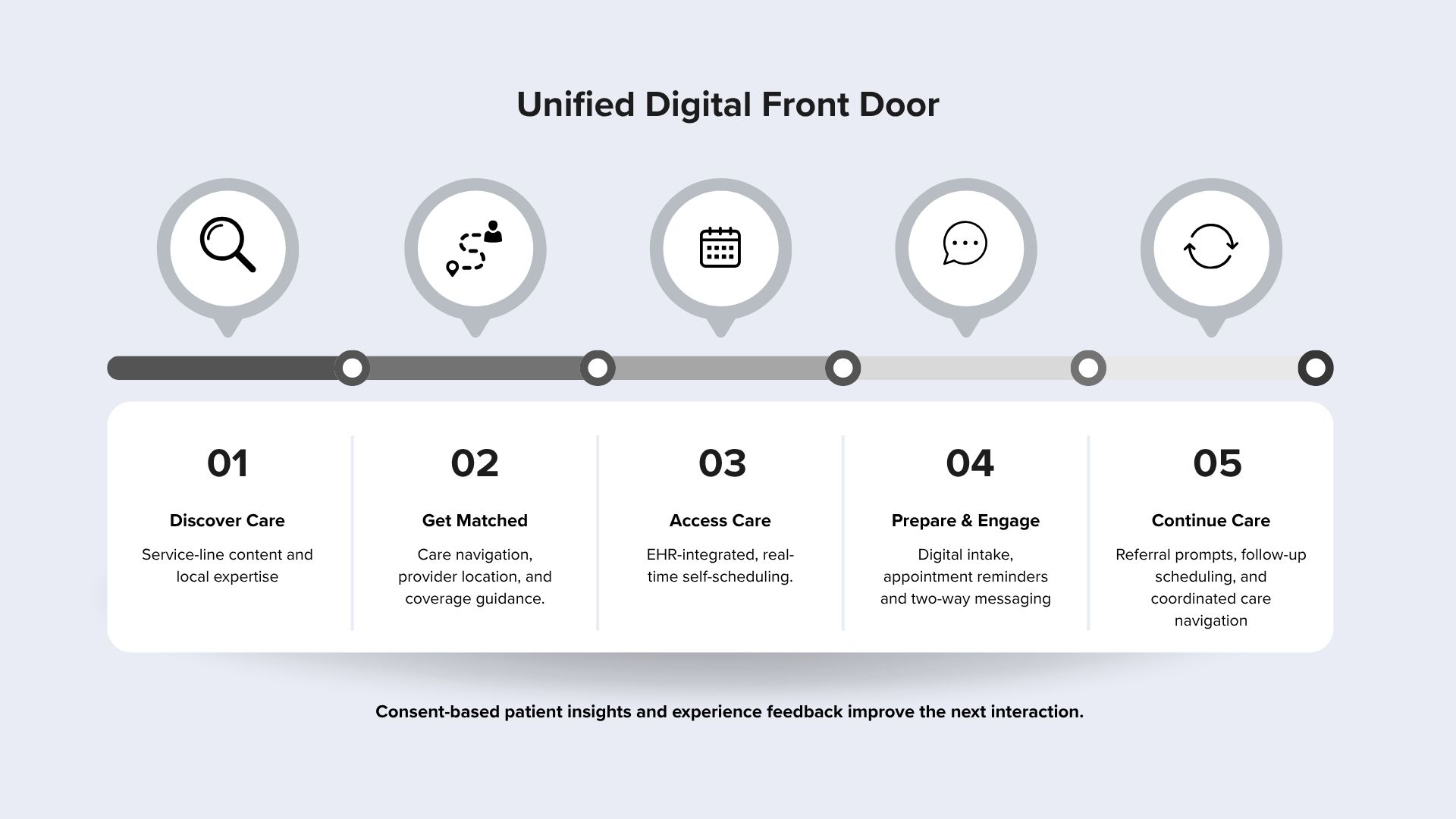
Designed a unified digital front door to simplify service discovery and access.
Strengthened referral pathways to improve care continuity and reduce patient leakage.
Patient-centered brand strategy
The health system’s institutional positioning was transformed into a patient-centered brand strategy focused on accessible expertise, convenience, and coordinated care across service lines. Rather than relying primarily on academic prestige, the new narrative connected advanced clinical capabilities with a responsive local care experience.
This repositioned the health system as a compelling regional alternative while giving service lines a unified value proposition to support patient acquisition, retention, and growth.
Unified Digital Front Door
With the brand promise established, the digital ecosystem was redesigned around the patient’s journey from service discovery to access. A unified digital front door replaced fragmented websites and appointment-request forms with real-time self-scheduling integrated into the electronic health record.
Consumer data and two-way messaging connected previously disconnected interactions, creating a more personalized path to care. The resulting infrastructure expanded patient self-service, reduced administrative demands, and created a scalable foundation for service-line growth.
Connected Referral Pathways
Although the digital front door simplified initial access, patient retention still depended on reducing friction during transitions between primary, specialty, and hospital-based care. To address these gaps, connected referral pathways replaced manual workflows with EHR-triggered notifications, prompting patients to schedule recommended follow-up care.
By aligning marketing, technology, and clinical operations around shared access workflows, the model also reduced administrative delays and strengthened continuity across care settings. As a result, patients experienced a more coordinated path to care, which helped the health system retain referrals, support growth in specialty services, and differentiate through easier local access.
Build a connected patient experience that streamlines access to care and accelerates service-line growth.