USA Clinics Group operated three specialty-care brands providing minimally invasive treatments for venous disease, peripheral artery disease, and uterine fibroids. Rapid expansion exposed fragmented brands, disconnected acquisition programs, and inconsistent clinic operations that could not support growth efficiently. Leadership engaged me to build an integrated growth engine capable of scaling patient demand across brands, locations, and local markets. I designed an enterprise growth model around three strategic priorities:
Unified three specialty-care brands around differentiated patient value and shared standards.
Built a localized omnichannel model to increase qualified patient demand.
Scaled network expansion without proportionally increasing acquisition costs.
Multi-Brand Patient Value Architecture
Rapid expansion required each specialty brand to maintain a distinct clinical identity without duplicating the infrastructure supporting enterprise growth. The brand architecture therefore positioned each service line around patient outcomes while separating acquisition pathways according to condition and intent. The vein-care brand distinguished seasonal cosmetic demand from year-round medical needs, enabling more relevant education and patient journeys.
Meanwhile, vascular care emphasized mobility and independence, while fibroid care focused on education and minimally invasive alternatives to hysterectomy. Shared governance, creative standards, and medical-review protocols unified execution across the three brands without diluting their clinical identities.
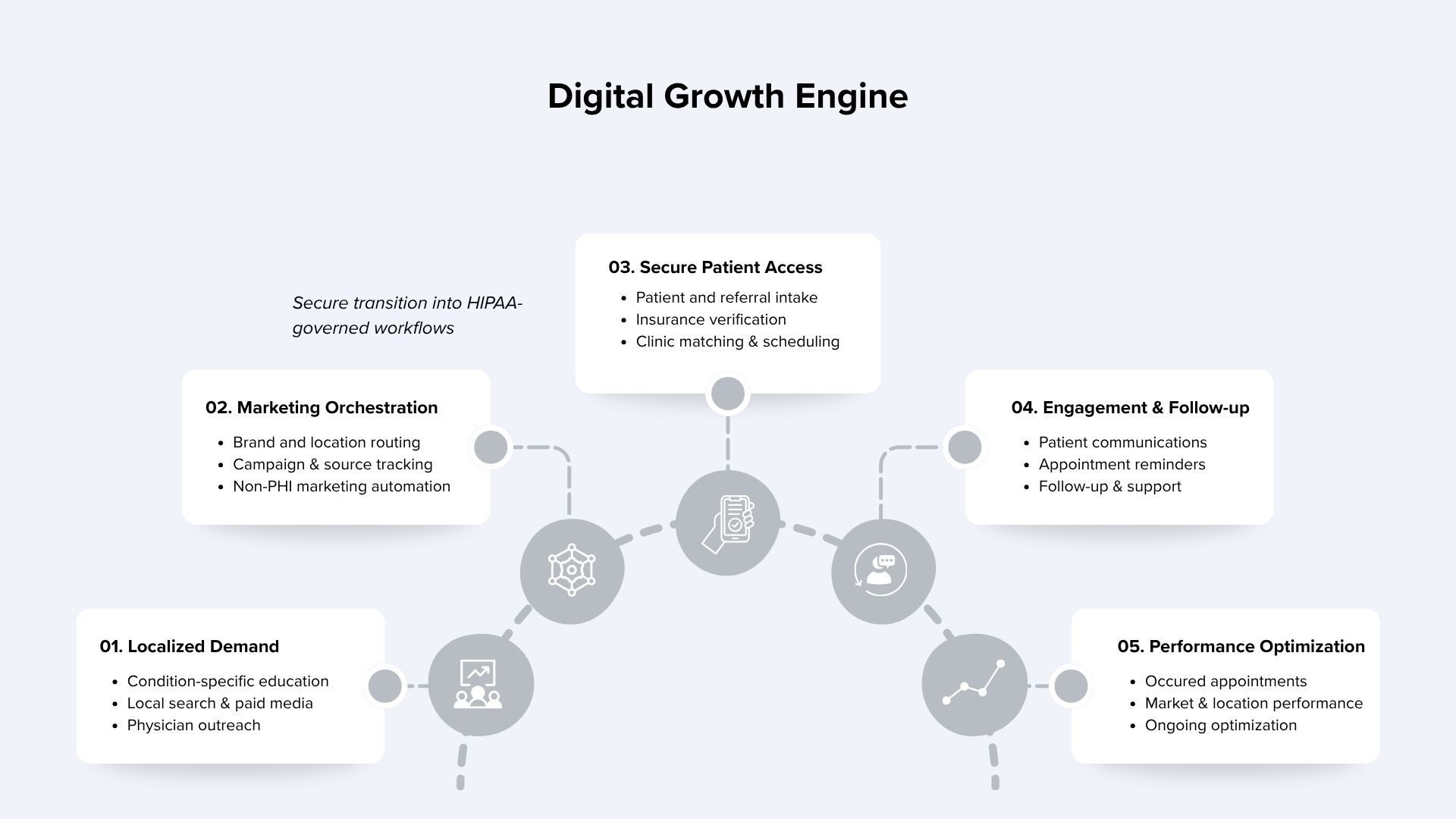
Digital growth engine
To diversify growth, a centralized acquisition model coordinated direct patient marketing with targeted engagement of referring physicians. HubSpot supported marketing automation and lead management, while protected patient information remained within the secure clinical systems and workflows.
Insurance verification was integrated into the scheduling journey, helping patients identify eligible local clinics while reducing uncertainty before booking a consultation.
Together, this architecture strengthened patient relevance and trust while creating a repeatable foundation for local-market activation and multi-brand growth.
Connected Referral Pathways
Rapid geographic expansion required a repeatable market-entry model that could activate patient demand while protecting brand consistency and acquisition efficiency.
To meet this need, a 60-day new-clinic playbook standardized the sequence, ownership, and performance requirements for every market launch. Before opening, centralized teams established local foundations for discovery, provider outreach, patient acquisition, and reputation building within each clinic’s service area.
Because clinical capacity was essential to growth, digital recruitment campaigns also supported the hiring of specialized physicians in priority markets. Once clinics opened, centralized reputation management strengthened local credibility by coordinating patient feedback and provider profiles across the network.
Together, these capabilities accelerated local-market activation, and supported expansion without a proportional increase in marketing overhead.
Build a digital growth engine that converts localized demand for specialty care into scalable expansion.